

Hotel Massila
A Tall Thin Man
The little three-story hotel stands immediately behind and below the Hotel Rembrandt, just a few yards down the steeply sloping Rue Ibn Joubair — Rue Marco Polo, as it was known in the days of the International Zone. From here, there’s a clear view all the way down to the Avenue d’Espagne, the elegant esplanade lined with palms that curves along the bay front and the wide sandy Tangier beach. At the time of Burroughs’ visit, Paul Bowles was staying in the Massila Hotel with his painter friend, Ahmed Yacoubi. Jane, recently back in Tangier after two years in New York, was living temporarily at the Rembrandt — where Tennessee Williams and Frank Merlo were also staying — before she moved into the cramped house the Bowleses owned in the Place Amrah, high up inside the medina. Jane called by the Massila daily that spring of 1954 to care for her husband, who spent three weeks there in a cold, damp room recovering from paratyphoid.
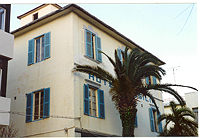
Hotel Massila, view from below (photograph by Oliver Harris)
“During my convalescence a tall thin man came to see me,” Bowles recalled in Without Stopping (1972). “His manner was subdued to the point of making his presence in the room seem tentative. I recalled having seen him before from time to time, walking in the street, not looking to right or left. We continued to cross each other’s path, and now we nodded” (323).
The account of Burroughs’ visit in spring 1954 is well known, as is its upshot: just as with his first encounter with Brion Gysin at the nearby Hotel Rembrandt three months earlier, so too with Bowles now — nothing came of it at the time. Each rendezvous, which promised so much, seemed a dead-end. “I stayed very briefly, I would say about ten minutes, and that was the end of that,” as Burroughs later put it. “He was quite neutral, not surprisingly. We moved in completely different circles” (quoted in Christopher Sawyer-Laucanno, An Invisible Spectator: A Biography of Paul Bowles, 315).
If Burroughs had appeared too Spanish for Gysin’s taste — figuratively, still trailing bullfight posters from Mexico — so, to Paul Bowles, he appeared (or at least so Burroughs assumed) too dangerous. In a phrase frosted with dry formality, he noted in a letter to Kerouac a couple of months later that Bowles had “evinced no cordiality” when they’d met at the Massila, and he guessed it was because he didn’t “want anybody tracking heat into his trap” (Letters 224). Since Bowles’ circle included the likes of Tennessee Williams and Truman Capote, the rebuff confirmed Burroughs’ social isolation in Tangier.
But Burroughs didn’t only want Bowles’ company; he wanted Bowles’ success as a writer and the exotic glamour of an expatriate life. What he had was a heroin habit, a writing block, and no friends in a foreign city. One of the reasons Burroughs always gave for wanting to go to Tangier was reading Bowles’ Tangier-set novel, Let It Come Down (published in February 1952), and now he seemed to find himself in the place not of its enigmatic author, but of its doomed hero, Nelson Dyar, telling himself that “when he arrived he would be like another person, full of life, delivered from the sense of despair that had weighed on him for so long. And now he realized that he felt exactly the same . . .” (17).
Interzone Has Had it
Unsurprisingly, perhaps, there is a sour edge to Burroughs’ fantasy of Bowles, sketched in December 1954, as Andrew Keif, “the brilliant, decadent young novelist who lives in a remodelled pissoir in the red-light district of the Native Quarter” (149). Keeping this description in Naked Lunch — long after they had become friends — was a reminder of both the romance of the writing life that had drawn Burroughs to Tangier and his own years of failure to achieve anything like it.
The Burroughs-Bowles connection in fact predates their meeting in Tangier, their paths having criss-crossed without actually connecting many times previously. Having just missed each other in Mexico and Panama, they did so again in New York: while Burroughs had been staying with Ginsberg in his East 7th Street apartment during the fall of 1953, Paul and Jane Bowles had been living on the other side of Greenwich Village in their penthouse on West 10th Street. According to some accounts, Jane resembled Burroughs’ wife, Joan, not only physically but as equally intelligent, self-tormented women who stood by their homosexual husbands. Maybe Burroughs noticed the similarities; whenever he referred to Joan in his writing (and he rarely did), he changed the name to Jane.
Paul had known Jane since 1937, when he had been introduced to her by the lyricist John La Touche. Two years later, Burroughs came to know La Touche himself through Ilse Klapper, the German-Jewish refugee he had married to get out of Europe. La Touche did funny skits of everyone, including Burroughs: “I’m Bill Burroughs and I’ve got a gun. Don’t come near me” (Morgan 71). In Tangier, La Touche’s little skit — his mini routine — seemed spot on, and Burroughs would build one of his own routines around the “ominous figure” of William Lee, scaring off thinly-veiled portraits of Bowles and Yacoubi:
“A successful composer says to his protégé, a young Arab poet: ‘Start packing Titmouse. I just saw Willy Lee in the Socco Chico. Interzone has had it’” (Interzone 92).
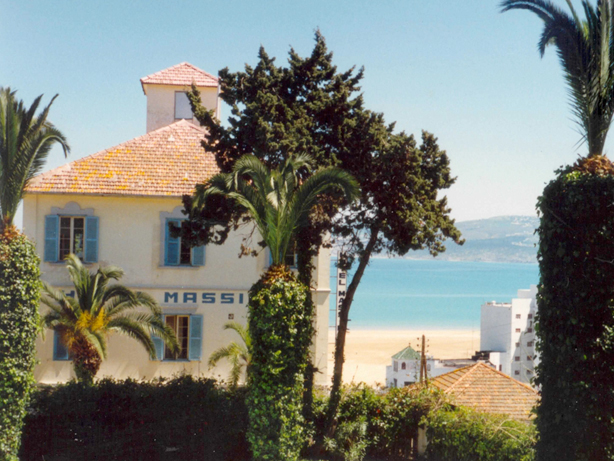
Hotel Massila, view from Hotel Rembrandt (photograph by Oliver Harris)
Like A Revelation
That day in May 1954 at the Massila, Burroughs had tried to talk shop with Bowles, asking him for advice about his contract for Junkie with Ace Books. Perhaps the Bowles-Burroughs encounter would have flourished immediately had they discussed a less prosaic subject — had they, for example, asked one another about the Tangier of their dreams. This association has been such a commonplace — as in the titles of both Ian Finlayson’s Tangier: City of the Dream (1992) and Michelle Green’s The Dream at the End of the World: Paul Bowles and the Literary Renegades in Tangier (1992) — that it sounds trite rather than compelling, except perhaps to those who have known the allure of the city at first hand.
But the dream dimension was central for both writers, and Bowles would give it a very precise architectural grounding: “If I said that Tangier struck me as a dream city, I should mean it in the strict sense. Its topography was rich in prototypical dream scenes … as well as the classical dream equipment of tunnels, ramparts, ruins, dungeons, and cliffs” (Without Stopping 128). While for Bowles the town seemed to be an Expressionist set designed by Dr. Caligari, for Burroughs it was a model for his more surrealistic Interzone, because here the physical world coincided with another reality: “Tangier seems to exist on several dimensions,” he wrote in “International Zone.” “Here fact merges into dream, and dreams erupt into the real world” (Interzone 58).
This is why Burroughs should have asked Bowles about the Tangier of his dreams:
“One balmy night in May [1947], asleep in my quiet bedroom, I had a dream,” Bowles recalled in Without Stopping. “In the late afternoon sunlight I walked slowly through complex and tunnelled streets. As I reviewed it, lying there, sorry to have left the place behind, I realized with a jolt that the magic city really existed. It was Tangier” (274).
In Bowles’ account, this dream-recognition was the reason he went back to live in the city he had first visited in 1931. The siren song of Tangier also called out to Burroughs through a spectacular moment of déja-vu: “Tanger is my dream town,” he wrote in October 1956, tracing it back to reveries he had had at the precise time of Bowles’ own dream of the dream city: “I did have a dream ten years ago of coming into a harbor and knowing that this was the place where I desired to be . . . Just the other day, rowing around in the harbor I recognised it as my dream bay” (Letters 330). No coincidence, then, that in this same letter Burroughs reported he was now getting “quite friendly with Paul Bowles” (329), nor that two weeks later he should announce that their minds were so similar “telepathy flowed like water”: “I mean there is something portentously familiar about him, like a revelation” (337).
In Tangier, both Burroughs and Bowles were at home in their Dream Town. But taking the fantasy literally was not an option for the real Tanjawis, for whom the expatriates’ dreams were in many ways their worst nightmares. Equally, this was a fantasy whose allure was not just the promise of forbidden pleasures but the lure of self-destruction. A fatal fantasy: Tangier as femme fatale — an identity invoked most enigmatically in Billy Wilder’s early noir classic from 1944, Double Indemnity. Through the film’s final scene, drifting in gunsmoke over the dead femme fatale (Barbara Stanywck) and her dying lover (Fred MacMurray), floats softly the 1941 hit tune by Victor Schertzinger — no need for any filmgoer in those days to actually hear the Johnny Mercer lyrics — of “Tangerine”: “Yes, she has them all on the run, but her heart belongs to just one. Her heart belongs to Tan-ger-ine, Tangerine.”
(Text: Oliver Harris)

