

Murphy’s Lawless
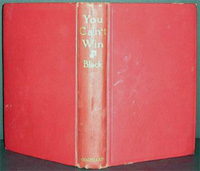
The “Good Red Book” — Jack Black, You Can’t Win, 1926
I first read You Can’t Win in 1926, in an edition bound in red cardboard. Stultified and confined by middle class St. Louis mores, I was fascinated by this glimpse into an underworld of seedy rooming-houses, pool parlors, cat houses and opium dens, of bull pens and cat burglars and hobo jungles. I learned about the Johnson Family of good bums and thieves, with a code of conduct that made more sense to me than the arbitrary, hypocritical rules that were taken for granted as being “right” by my peers.
The above quote, from an introduction William Burroughs wrote for a reprint of Jack Black’s You Can’t Win, a 1926 book about the criminal classes, shows why the 1942 trip he made to Chicago, the second of his two formative experiences there, was so important to him. After his very early reading of the Good Red Book (as he refers to it in the intro, giving an idea of its Biblical significance to him), Burroughs lived by its hoodlum dictums for the rest of his life, splitting the world into “Johnsons” (i.e. good people) and “shits” (i.e. — well, you get the idea). You can understand how a book about lowlife-jive dive-living would appeal to a dreamy affected disaffected boy from a cloistered, stuffy unemotional environment like the one Burroughs came from. After all, other social stations always look better than the ones we’re at, and the ones on top want to vicariously live through and be like the ones on bottom want to be vicariously like the ones on top, at least money-wise.
Chicago was Burroughs’ first deliberate attempt to live outside his past privileged position. After he was drafted in the summer of 1942, his much-loved mother contacted a Washington neurologist who got Burroughs out of the army on a civilian disability discharge. At Jefferson Barracks, Burroughs met a native Irishman called Ray Masterson, who told him that jobs were plentiful in the Windy City. In September Burroughs moved back to Chicago, a place that had already deeply branded itself on his impressionable brain during his study of General Semantics.
Burroughs stayed at Mrs. Hattie Murphy’s rooming house at 4144 N. Kenmore and lived among a drunken osteopath on the spirits, drifters and grifters and gamblers and thieves and young war veterans, rolling like a pig in working class shit and slumming it with “Johnson” bum-scum. His view of the lower classes was naïve and somewhat condescending, ascribing an impure purity to them that of course they do not possess; but hey, it certainly beat being a deliveryman for mater and pater.
On Saturday, April 11, 2009, I put on my RE/Search Burroughs tee-shirt and took a trip to the N. Kenmore area to photograph Burroughs’ old digs. To get the address I went to the Harold Washington Library’s microfiche section a few weeks before and waded through old scratchy sometimes-barely-legible phone books. By a process of elimination I found, under “furnished rooms,” the above name and address and later had it independently confirmed by Burroughs scholar Oliver Harris. So it was definitely the right place. Though I couldn’t find a classified ad for this exact address, other buildings in the same street show rooms as being $4 a week at this time period, or $5 with a private bathroom.
I have to say, though, that the place must have moved up in the world since El Hombre Invisible stayed there 67 years ago, because the quiet middle-class residential area I found (oddly a single street across from a place I had given a reading of my own stuff the night before, not knowing I would be back that way far sooner than I ever expected) was pretty far from seedy and sleazy and edgy. N. Kenmore is now a mishmash of old and new tenement buildings, tree-lined, speedbump-landmined, and quiet as the graveyard round the corner. And as for 4144 N. Kenmore itself, well…
I was all excited when I pulled up to the 1940s-looking building I assumed was the place, but on closer inspection the numbers only went up to 4142. They then jumped to 4150, a brand new construction of 23 (that number Burroughs hated and had a superstitious fear of) 2-and-3-bedroom expensive condos.
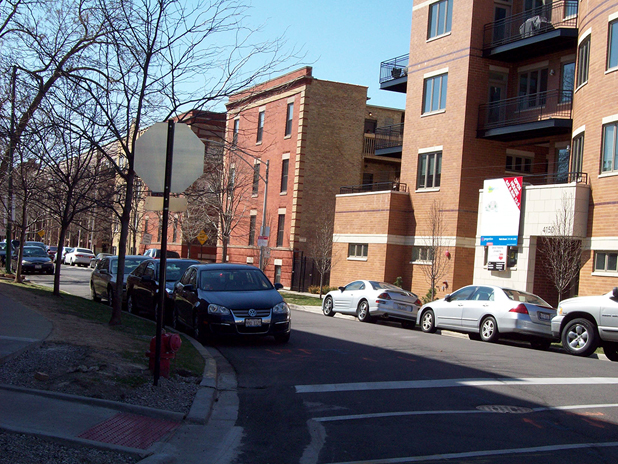
4142 to 4150 North Kenmore, Chicago
At first I assumed I had made a mistake and went round the back of elevated-train-backed 4142 to see if I could find a smaller hidden building to account for the numerical gap. No such luck. I hesitantly climbed a set of wooden stairs a couple of floors, hoping to find the desired address. I knocked on a door and a pleasant young couple told me that 4144 was nowhere round here. The woman told me she was on the board for the building and that the new building next door, 4150, had been constructed on a lot with no foundation on it, so there couldn’t have been a building there before. This didn’t make much sense — why would the numbering jump like that, and why would there be such an awkward juxtaposition of old and new construction? The only conclusion I could construct was that, unless there was a typo in the old phone book I had used to locate it, 4144 N. Kenmore, Burroughs’ old Chicago flophouse haunt…
… quite simply no longer exists anymore, having unfortunately been torn down and built over.
Anyway. While WSB was living at the now nonexistent residence, he undertook a series of jobs beneath his stately station — guess he didn’t have a problem lowering himself if there was no chance of being mobilized to a European battlefront. He took a job in a factory as a bolt-mover, but couldn’t hack more than three brain-deadening days of that bollocks and bolted. Classified ads for factory workers during late 1942 give an idea why. The offered wages varied from 45c-60c an hour (working for 50c, Burroughs would have had to work for more than two full inflation-adjusted-price weeks to pay for his Korzybski seminar series of 1939), with companies looking for “coloreds” (there is an offensive and darkly humorous racial element to the ads that wouldn’t be tolerated for a second these days), “elderly” and “draft exempt” — at a stretch I would guess that William fit into the latter category of these seemingly frowned-upon elements of the early 1940s Chicago employment market.
Oddly for a man who would later go on to have a brief unsuccessful attempt at being a hold-up man, Burroughs also signed on with Merit Protective Services, a store detective agency that caught employees with their fingers in the till. Assuming the name is correct, I could find no mention of this company in the microfiche in the library or in online Chicago newspaper archives, but other store detective ads from the period say that “experience is necessary” and lists of previous employers must be provided. With these criteria, I can only assume that Merit thought that Burroughs seemed so upper crust that he would do a good job. Or maybe he greased a palm or two. Or maybe they were just desperate for workers.
Merit (also seen it spelled “Merritt”) ran from a building at 612 North Michigan Avenue that has now been demolished. It seems likely that the operation was just a small outfit in a building full of businesses because other organizations, including a beauty parlor and a place urging people to buy one of their poultry houses and raise chickens(!), come up in the same 1942 time period when searching for this address in newspaper archives. The detective work must have suited the wannabe-spy in Burroughs because in 1944 he worked in New York as a detective again, with the job being fictionalized in And The Hippos Were Boiled in Their Tanks, an early abortive work by Burroughs and Jack Kerouac. In Hippos (a not-hugely-interesting work accurately described by the local librarian who helped me find a misfiled copy of it as a “two glass of beer book”), James Grauerholz explains the nature of the nascent writer’s employment when WSB first heard of Dave Kammerer’s murder by Lucien Carr (which the book is based on):
Bill was across town in the Lexington Hotel, working a divorce case for the William E. Shorten detective agency. He was to listen for “amorous noises” in the adjacent hotel room, where the target couple had made reservations — but they never checked in.
So Burroughs went from keeping fingers out of tills to keeping other bodily parts out of places they should never have been either.
Two friends visited Burroughs in Chicago in the fall of 1942 from St. Louis, 17-year-old Lucien Carr and 31-year-old David Kammerer. The latter, of course, would be murdered by the former in a bizarre unrequited homosexual love feud in 1944, forming the basis for the writing of And the Hippos Were Boiled in Their Tanks. The jokey high-spirited duo got Burroughs kicked out of Mrs. Murphy’s dive-digs in 1943 for pissing out the window and tearing up a Gideon Bible (which would not have gone down well with the landlady if she was a good Catholic, as many Irish are). After a failed suicide attempt (or an attempt to get 4-F draft exemption), Carr was taken by his mother back to New York, with Burroughs and Kammerer soon following. It was an inglorious end to a formative time in a city Burroughs would never forget.
(Text: Graham Rae)

