

Space-Time Travel
“I am not American Express”
“Yagé is space-time travel …” (Naked Lunch 92) … and what goes for the Amazonian hallucinogen goes also for how Burroughs thought of his writing — as a form of spatio-temporal exploration. The imperative was there from the start with Junky (published in 1953 as Junkie), which began by exploring New York’s underground drug world and ended up over the border down in Mexico City — and which Burroughs described at the time as a “travel book more than anything else” (Letters 83). But back in May 1951, his notion of both travel and writing had not gone beyond a limited and limiting reportage (his first novel was, he insisted, “an accurate account of what I experienced during the time I was on junk”). Two years later, having travelled through the jungles of Ecuador and Peru to take his first trips on yagé, all the limits came off … to reveal the Composite City. More than a collage of cultural fragments, this was the model of a visionary cartography, sampling the known and intuiting the unknown to reach an uncanny realm he describes as “familiar to me but I could not quite place it. Part New York, part Mexico City and part Lima which I had not seen at this time” (Yage 18).
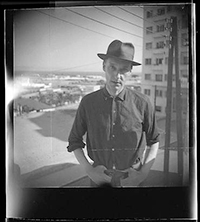
William S. Burroughs, Self-Portrait, circa 1959, Tangier
The seedy glamour of Burroughs’ urban noir habitats in the 1940s and of his life as an expatriate in Mexico and Morocco — all this entered into the general mythology of his reputation as well as the texts he wrote, and this is surely one reason for our interest in Naked Lunch as a travel book — which it is, of sorts… For the structure and aesthetics of this text are explicitly hostile to our finding what we normally look for — anchorage points of historical or biographical reference, the soothing certainties of genre, the progression of narrative, the stability of representation and space-time coherence. And so Burroughs does not, as the “Atrophied Preface” redundantly states, “spare The Reader stress of sudden space shifts and keep him Gentle” (182). On the contrary, the whole idea is to produce a very ungentle shift — like that of yagé, “a shift of viewpoint, an extension of consciousness beyond ordinary experience” (227).
The upshot is that we must look for the real places — from New York and Chicago to Tangier — and also look beyond them. Mapping the enigmatic traces of his footfalls becomes a way to discover not only where William Burroughs had been but where, via Naked Lunch, he was taking us…
(Text: Oliver Harris)

