

A Discography of Naked Lunch
The Sound of the Underground
Judy Garland sings It’s A Long Way To Tipperary followed by Hoagy Carmichael’s immortal rendition of Stardust. Then Duke Ellington and his Orchestra come in with St Louis Toodle-Oo, seguing into Manhattan Serenade. Queue Arty Shaw and his liquorice stick performing the terrifying Nightmare and My Heart Belongs To Daddy. . . Behind the détournement and usurpation of popular music and song which permeates Naked Lunch there are actual recordings known by Burroughs and this discography will attempt to list those tracks and trace those sources, from Tin Pan Alley and film show-stoppers to supper club crooner ballads and Swing 78s and novelty rags on an old Victrola. . . Welcome to the true soundtrack of Burroughs’ savage musical divertissement in which entertainment is treated as a suppurating cultural sore — real Devil’s Music, machine-driven shlock, a medium of deadly possession.
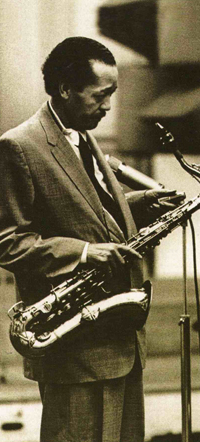
Lester Young in Paris, Spring, 1959, a few weeks before his death in the States. “He had changed music forever, but his gentle spirit could not bear to grow old.” (Donald Clarke).
The majority of Burroughs’ musical sources were utterly remote from 1960s pop culture, and despite his references to bebop and rock and roll, Naked Lunch is overwhelmingly a collage of recorded detritus from the the 1920s, 30s, and 40s. Despite retrospective rock cultural projection, it has nothing whatsoever to do with Steely Dan or Soft Machine — it is not “progresssive,” it is not remotely modern, it is knowingly nostalgic and perversely out of time. Burroughs exposes the ludicrous, tawdry potency of popular music and ridicules the patriotic and sentimental duplicity beneath which it operates — music as junk, shellac for the war machine, the heartbreak machine and the political rally, the Japanese Sandman selling “new dreams for old.” At the same time, Burroughs was clearly infiltrated by these songs and tunes, and though he wanted rid of them, wanted them out of here, he was also helplessly, emotionally attached. It is the music of the Jazz Age and the Depression to which Naked Lunch pays ambiguous homage, the era of radio broadcasts and piano rolls and vaudeville theatres. A haunting Duke Ellington melody, a wistful Hoagy Carmichael track, one of Judy Garland’s elegies to Danny Boy, a disc of Fletcher Henderson’s The Stampede (the 1926 or the 1937 version), the pure poetry of Lester Young playing in a downtown New York club or a Left Bank Paris nightspot . . . Music hath charms, and for Burroughs it conjured autumn leaves blown down a windy St Louis street, lost afternoons and distant roadhouses, eggshell-blue skies, the sharp pangs of regret for vanished times and doomed loves. Those songs and tunes were Proustian madeleines — however beautiful or kitsch, desired or unwanted, all were redolent of mortality and loss.
Critics and readers have passed over the lacerating critiques, appalled parodies and tender musical evocations which permeate Naked Lunch. A special dossier entitled “A Little Night Music” will appear in the book Naked Lunch@50: Anniversary Essays, examining this important and neglected area, while this section of nakedlunch.org will provide detailed information on the songs and melodies, singers, musicians and songwriters whose work is savaged, ridiculed and melancholically replayed throughout the book — underground music, strangely unnoticed, and unheard, for fifty years.
More to come…
(Text: Ian MacFadyen, February 2009)

