

1 Calle de los Arcos
Burroughs arrived in Tangier from Gibraltar via a short stay in Rome the first week of January 1954, but surprisingly little is known about where he first lived. We know its address — 1 Calle de los Arcos — and that it was a male brothel where he rented a room from Anthony Reisthorst, or, as Burroughs described him that April, “Tony, the old Dutch man who runs this whore house I live in” (Letters 203). To the best of my knowledge, there are no photographs, either taken by Burroughs at the time or by later researchers, and no markers of Calle de los Arcos on any map.
After staying in hotels his first few weeks in Tangier, Burroughs moved into Dutch Tony’s in early February — around the time of his fortieth birthday — on the ninth of the month reporting to Ginsberg that he had “a room in best district for 50 cents per day” (196). Where was this “best district?” Burroughs’ biographers merely agree that his room was “near the Socco Chico” (Miles 62; Morgan 239), in the centre of the medina. The first time I arrived in Tangier, some thirty years after Burroughs, this was the place I went in search of first.
There wasn’t much to go on back in the mid-1980s. This was before either of the Burroughs biographies, or literary histories of Tangier by the likes of Iain Finlayson and Michelle Greene or even the first Rough Guide to Morocco, and long before the maps and data available on the internet. Until I found an old French map of the medina which lacked any street names — most of which had, in any event, been changed since the old International Zone days — all I had to go on was what I hoped to pick up from the local Tanjawis.
Mediocre French will get you places in the nouvelle ville of Tanger, but in the medina to speak with anyone old enough to remember the 1950s, or who might know where to find Calle de los Arcos, you needed Spanish, which I didn’t have. Then again, what help could you expect in following a trail three decades cold? And what was I looking for? The house of a Westerner who had lived in Tangier in the last days of its colonial rule mainly to take advantage of drugs and young boys, and whose fame rested on a blasphemous book…
In the Socco Chico
What I hadn’t reckoned with in Tangier were the guides who offered their services at every turn. Some twenty years on, I forget exactly how it came about, but to my astonishment one young guide standing in the Socco Chico answered my query by immediately pointing a few yards away from where we were. Just to the right of the Café Central, the café of choice for Burroughs and his generation, there was a small opening. The blue plaque on the wall read: Calle del Arco.
This little tunnel was not it, I quickly realised. After twenty feet, the depth of the Café Central, Calle del Arco opened onto a small cross street, Khayatine, that in turn connected two long alleys, Rue des Chrétiens (or Rue des Almohades) on the left side and Rue de Commerce on the right. (The mix of old French or Spanish names and new Arab ones was, I discovered, an added confusion, both a mundane fact and a curious perversity, as if the city refused to be fixed by being named. Needless to say, in Burroughs’ letters, Tangier is never simply Tangier, but also Tanger, Tangiers…) Standing in this dark tunnel, it was obvious there was simply no space here for Dutch Tony’s, and besides, this wasn’t “near” the Socco Chico; it was effectively in it.
Undeterred, I decided to rise early each morning — before the medina alleyways became impossibly crowded — armed with a notebook, pencil, and camera, to map the entire place, if that’s what it took to follow in Burroughs’ steps.
Mapping the Medina
Although the medina has many entrances — via Rue d’Italie on its west side, the Kasbah to the north, the port gates to the east — the natural starting point was the sprawling open space of the Socco Grande, which lies immediately below the medina and stands between it and the boulevards of the nouvelle ville built by the French after the turn of the century. Passing through the forty-foot high horseshoe archway of the Bab el Fahs, you enter the medina, heading north and east, downhill towards the Socco Chico along the Rue es Siaghines — the Street of the Silversmiths, which was lined with money changers in the International Zone era. Paradoxically, this is the most deceptive street in the medina. The only route straight and broad enough for a car, it gives no hint to the Westerner of the transformed experience of space (and, thereby, time) that lies in wait beyond it.
Even on the empty alleyways of early mornings, space in the medina shrinks extraordinarily, becomes broken up into fragments of unaccustomed density, as the path suddenly shifts from sunlight to obscurity and twists so frequently and unexpectedly that you rarely see more than a few dozen yards ahead. After a year of living inside the medina, Burroughs wrote that: “Tangier seems to exist on several dimensions. You are always finding streets, squares, parks you never saw before” (Interzone 58). But the opposite is equally true, and just as uncanny: going around in circles, you find yourself back at the same places again and again. To know the medina is a “labyrinth” tells you nothing about this experience of space-time — but, looking back, it was this disorientation that my early map fragments tried to master.
Reading the Signs
At a certain point I must have pulled back from this insane digression, this hopeless ambition to map it all, long enough to ask again the whereabouts of Calle de los Arcos. I don’t remember the man who led me there, but I can recall my initial exasperation. For I had passed the opening of this tiny alley a dozen times as I walked along the bustling Rue Naciri (or Calle Naciria), and even noted down its name (see top of figure 2) without making the connection: Rue El Kouasse — a plausible transposition of “los Arcos.” Quite literally, I had not known how to read the signs.
A Hole in Space-Time
As I took photographs and mapped every twist, turn, and blind alley in the vicinity, I tried to picture Burroughs living here, in the lower west side of the medina of Tangier. He had stayed for some eight months altogether — from February to early September 1954 and again, after three months away in the United States, from early December to early January 1955. Here it was that he’d fallen into despair in Spring 1954, when Ginsberg, travelling in Mexico, failed to respond to his daily letters — letters that rehearsed the frantic early routines that went into Naked Lunch. It was here that he endured the crisis of his addiction to Eukodol, so acute he paid a fellow lodger, Eric Gifford, to confiscate his clothes and prevent him leaving to buy more from the farmacias. And it was here that he had written numerous short pieces that never made it into Naked Lunch, later published in the Interzone collection, such as “The Finger” or “In the Café Central” and “International Zone.”
I tried to picture Burroughs’ life in this tiny alleyway, but my imagination failed me. Perhaps the medina was just too alien to my experience, or the years that had passed and the distance between myself and Burroughs were simply too great. Perhaps this Rue El Kouasse wasn’t even Calle de los Arcos after all.
My mapmaking grew ever more complicated, and was eventually traced, together with markers of my many hundreds of photographs, onto the old French map of the medina I later discovered.
Fig. 16 Old French map of medina |
Fig. 17 Map of lower left side medina |
In pursuit of El Hombre Invisible, I had filled in almost all the blanks on the map, but created a paper labyrinth with an irretrievable hole in space-time at its centre. Only years later, reading and re-reading Naked Lunch, have I come to think of this as entirely fitting; indeed, for me at least, the most desirable, the only possible, response.
(Text: Oliver Harris)
Mapping Burroughs’ Interzone
“The present novel is an attempt to create my future. In a sense it is a guidebook, a map…”

Modern Map of Tangier
This was Burroughs writing from Tangier in late October 1955, and the map — used here to describe the as-yet unrealized worlds of his work-in-progress, “Interzone,” later transformed into Naked Lunch — is a metaphor that runs throughout his work all the way to The Place of Dead Roads (where a literal map precedes the text) and The Western Lands, his final guidebook and Book of the Dead.
It’s surely no coincidence that Burroughs’ last novel ends, immediately before quoting T.S. Eliot’s lines about temporal closure (”Hurry up, please. It’s time.”), with reference to the closure of one particular drinking spot from the past: “In Tangier the Parade Bar is closed. Shadows are falling on the Mountain.” Long after he lived there, Tangier meant something special to Burroughs. But of course, Burroughs’ mapping is far from conventionally representational, and Naked Lunch presents a deliberately disorienting deconstruction of known or even knowable times and places. So any project to map the scene of its writing runs the risk of being not only reductive but positively anti-Burroughsian — making his chaotic fictional cartography seem reassuringly grounded in the familiar physical world, rather than a scrambled, collagist coding and projection of possible new ones. This is a necessary caveat to these Tangier Maps.
There And Not There
One of the most striking features of Naked Lunch in the popular imagination and in critical reception is the force with which it is associated with Tangier. Almost everything ever written about Burroughs’ masterpiece insists on the connection, and of course it is central to David Cronenberg’s contentious but very influential film adaptation. Burroughs worked on Naked Lunch in several other cities — chiefly, Copenhagen and Paris — and his text is infused with the flavour and descriptions of many places — from New York City, where the narrative begins and ends, to the Southern United States, Mexico, South America, and fantasy locations such as Freeland and Interzone — but the link to Tangier is inevitable: this was the inspiration and stage for the better part of Naked Lunch’s creation.
And yet, for a book written in Tangier, the fact remains that Naked Lunch has far more direct representations of North America than North Africa. Apart from the “Market” and “Ordinary Men and Women” sections, Burroughs seems to have relatively little to say about the city where he lived and wrote for four years. We assume it is there, but on closer inspection it’s hardly there at all.
Or rather, to grasp its real importance to Naked Lunch, we need to look beyond the locations of Burroughs’ Tangier towards the logic they suggested — which is to say, towards not anything represented in the text but towards the form of representation itself. Paradoxically, the secret of Interzone is everywhere in Naked Lunch, in its baffling juxtapositions, jump-cuts, lacunae, obscurities, and repetitions, in its frustrating blank spaces and seductive dead-ends. The process of mapping Interzone begins with physical places, but will never end there . . .
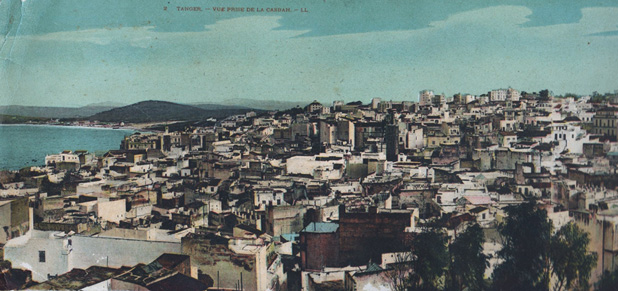
Detective Work
His Tangier years (January 1954 - January 1958) are a familiar scene to anyone remotely interested in Burroughs, and are vividly documented in his letters from that time, and yet there are surprising gaps in the record, a lack of detail about even the most basic facts.
For example, there’s no shortage of accounts and pictures of the Villa Muniria, where Burroughs lived for his last two years in Tangier, and which has now become a standard tourist attraction — but there’s almost nothing about the three other places he stayed during his first two years. Anyone wanting to know where on the map of the city those places were or what they looked like will look in vain — unless they go to Tangier and do their own detective work.

Iain Finlayson and Oliver Harris, Tangier
For almost a decade — from the mid-1980s until the early ’90s — that’s precisely what I myself did, and what follows is an incremental illustrated journey through the Tangier of the Naked Lunch years. It covers both the key biographical encounters — such as Burroughs’ first meetings with Brion Gysin and Paul Bowles — and some of the locations around the city that inspired Interzone. Since this is as much a personal journey as anything else, it also intersects with the project that drew me back to Tangier over and again — a mission to map and photograph the labyrinthine medina that Burroughs first entered in January 1954.
Those years survive as glimpses of a past time itself in search of a past almost already gone, its denizens fading out into sepia-toned photographs or turned to dust: dim recollections of an evening with Gavin Lambert on the Old Mountain, of brief encounters with Hamri and Choukri at the Café Haffa (or was it the Café de Paris?) and afternoon teas with Paul Bowles watched over by the suspicious eyes of Mohammed Mrabet, of sitting in the Socco Chico with Ira Cohen and Terry Wilson, or that day in the American Bookshop with Iain Finlayson (then researching his book City of the Dream) interviewing Madame Gerofi together in our terrible French — and the puzzled looks of unknown Moroccans as I walked the alleyways of their medina in the early morning light, tracing my path in a notebook, a young wandering soul walking in someone else’s old phantom footsteps . . . That cartographic project was abandoned in a leather trunk and left all these years to gather dust, which I take as a salutary reminder that all mapping is selective and partial and therefore necessarily incomplete — and certainly no way to master the textual geography of Naked Lunch. The Tangier Maps that follow will, I hope, invite others to contribute additions or corrections, or just to confirm that certain spaces will always remain an inscrutable blank…
(Text: Oliver Harris)

